


I appreciate this isn’t something we’re all intrigued by, but I’ll do my best to weave in the right measure of intrigue, I hope. Have you ever stopped to ask yourself, “Why am I doing this?”
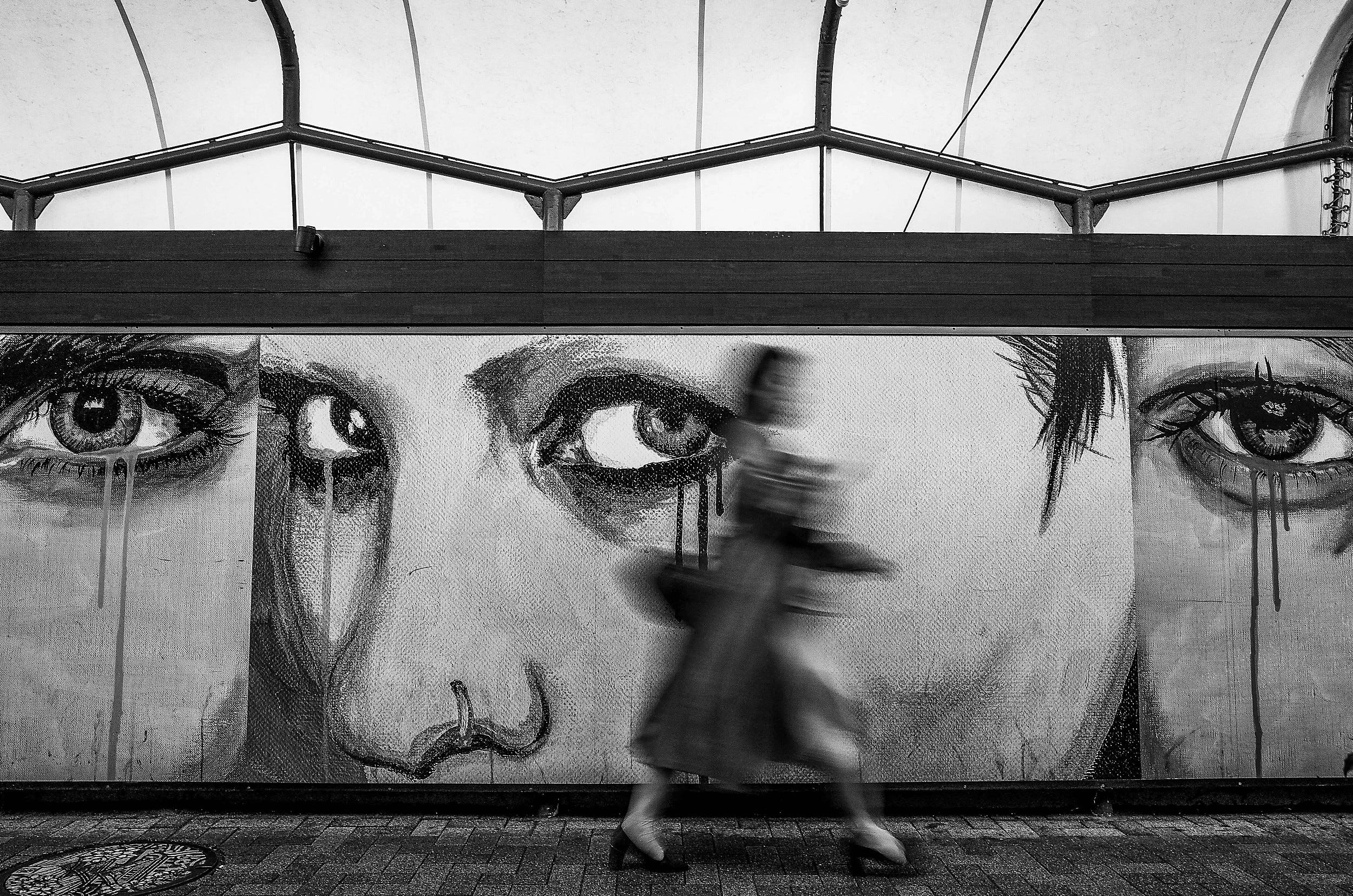
Pic: Masahiro Miyagi
I like the challenge of street photography, and it’s becoming something I’m starting to embrace more.
It’s a genre that’s interesting, and I think that’s down to the number of street photographers I’ve spoken with since starting this podcast. Prior to that, I had a clutch of friends who did street photography, but it certainly wasn’t a focal point in terms of personally trying it out.
Oh, I had the odd flutter, and I attended the odd workshop, and some of them were frankly a little odd, but I hadn’t been bitten by the observational bug I’d been promised.
On that note, in terms of the odd workshop throwaway comment, there was really nothing wrong with the workshops or indeed the tutors. I just couldn’t work out if they or I could figure out what was being taught or imparted in terms of teaching street. There was a disconnect between reason and value.
Does that make any sense? Perhaps it was the experience. I wasn’t seeing places I didn’t know already — perhaps that was the thing.
Anyway, I feel like I’ve just found a big, dirty shovel and I’m making a beautiful, big, round hole for myself.
Having said this, I was always intrigued by photographing strangers. I was and am being drawn to photographing complete strangers more and more.
Perhaps it’s the photographic element, perhaps it’s the challenge of subtlety and process, perhaps it’s the fact I quite like meeting new people and striking up a conversation, even though I am the proverbial coward in the face of a party and small talk.
So why do I like photographing strangers, and why do so many of us feel compelled to photograph people we’ve never met before in our lives?
Not for money. Not always for the project. And really, not for the “like.”
Just… because.
I don’t properly remember the first time I made a portrait of a stranger. I don’t mean a stolen picture — a quick click across the street of someone who’ll never know they were in your frame. I mean, one of those moments where I stopped, asked, and engaged.
But I know it would have been a little awkward, and even though in my newsroom days in radio, I had the job of recording the street vox pops, I am sure it would have been a stretch.
Because it’s different, isn’t it, in every way? There’s a more personal purpose in saying to someone, “Can I make a portrait of you? I’ve just noticed you,” than in saying, “Excuse me, do you have anything to say about the price of parking in the town centre?”
By the way, if ever you want a conversation starter — it may be an odd way to cue up a photograph — but I reckon the parking charges in a town centre car park would be a pretty good way to spark debate and then a portrait.
People turn into Mr and Mrs Angry beautifully when you talk about parking. I reckon you could probably move even the most demure, kind-spirited nun to vent with a question like that.
There’s a particular kind of connection you make when you photograph someone you don’t know. It’s quick, but it’s strangely intimate. A shared moment of trust between two people who may never speak again.
And even when that picture is made from a distance, when the subject is unaware, you’re still forming a kind of silent relationship. You’ve chosen them. Out of all the movement and mayhem of the street, your eye settled on that figure, their stance, the light falling just so.
Sometimes it’s aesthetic, as Sean points out on the Photowalk episode accompanying this today. A silhouette on a morning train platform. A figure against a wall of colour. But more often, it’s something else.
It’s presence.
We photograph strangers, I think, because we’re trying to feel connected.
The world can feel big, fast, sometimes overwhelming. But through the viewfinder, we slow down. We see the curl of a hand on a bag strap. The crease of thought across someone’s brow. The quiet dignity in a simple walk.
There’s also something deeply human about the curiosity behind a lens.
Who is that person? Where are they going? What have they seen?
We might never know, but the photograph becomes our way of saying: you mattered, in this moment.
Of course, not all stranger photography is simple.
We wrestle with ethics, with privacy, with the line between documentation and intrusion. Street photography in particular walks that tightrope between art and surveillance, between homage and harm.
But intention matters.
There’s a quote I found online, one of those anonymous ones, but it’s too good not to share: “A stranger is just a story you haven’t heard yet.”
When we make pictures of strangers, maybe we’re not trying to tell the whole story. Maybe we’re just saying, “I saw you.” And in a world of noise, that’s something quietly profound.
So the next time you find yourself reaching for the shutter as someone walks by, or you feel the courage to ask for a portrait, know this: You’re doing more than taking a picture.
You’re making a connection, however fleeting. And in doing so, you might just be offering the one thing that makes us all feel a little less alone.
Someone saw us.
And they cared enough to notice.
If all else fails, you could just ask, “Excuse me, do you have anything to say about the price of parking in the town centre?”