


Five, possibly seven kilograms. Possibly up to ten for a denser sweet or candy. That’s how much one of those big jars of sweets weighs.
Grandma lay spark out on the shop floor, beneath the ladder that stretched to the higher reaches of the display of jars filled with sweets.
“Rose,” said Grandad, “Rose!”
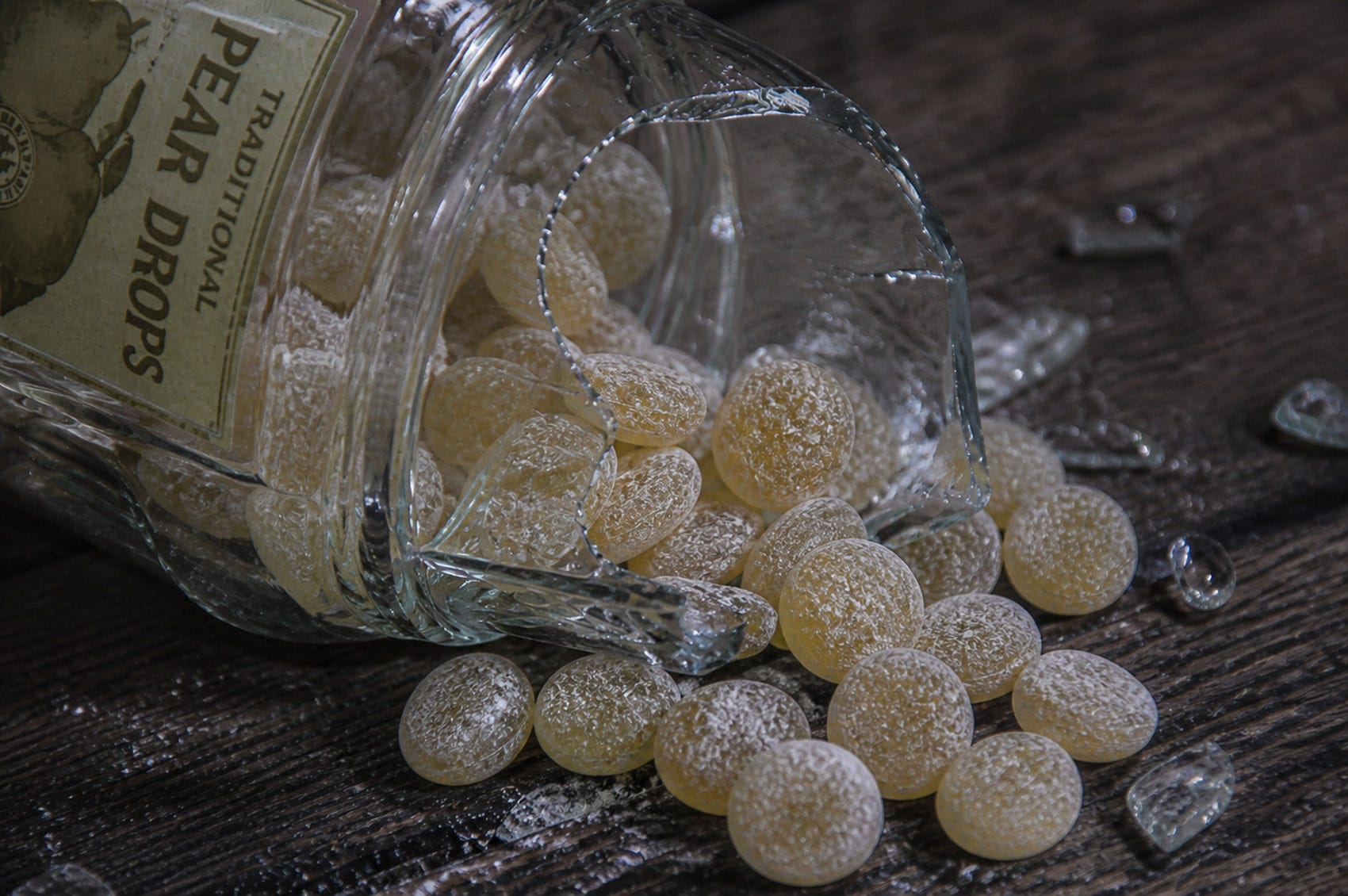
You might have thought his exasperated calls were down to concern for his wife, who’d just received a full jar of, let’s say Pear Drops for the sake of a good story, on her head from a height of at least a metre, possibly more. It was a clean strike, and had, to use a quaintism (if there is such an expression), knocked Grandma into next Tuesday.
She’d been polaxed, floored, slung a custard (proper old boxing term), ironed out, seen the stars, sent to the land of nod.
“Rose!”
Nothing, no movement.
“Rose, stop mucking about, I’ve another two jars to pass down.”
Unless you've heard or read the previous edition (Kid in a Candy Store), none of this makes much sense. You’ve missed the tour of my grandfather’s confectionery and tobacco shop, a gem of a past era, replaced by a shop with all the soul of the devil’s counting house. You also missed the way he unceremoniously destroyed an antique Fry’s Chocolates window with a golf ball one Christmas, trying to drive the ball from the open shop door across a busy arterial road into London, and the tour of his tobacco den where he mixed in secrecy special orders for visiting Tottenham Hotspur players on the way to a match. This is nineteen seventy something by the way; I can’t see world-class footballers dropping by H.A. Stewart’s in Enfield to stock up on their Woodbines prior to playing United on a Saturday.
Anyway, that’s probably set the scene, oh, along with this big librarian-style ladder on rollers that was used to reach a floor-to-ceiling array of every traditional sweet you can imagine in big glass jars that ran around the entire shop in a U shape.
“Rose! Rose!”
I think it was dawning on Grandad Harry that he’d actually badly hurt my grandmother by dropping a jar on her head, one that, whilst she was supposed to be catching them and had done so thousands of times before, on this occasion found her attention switch at just the wrong moment, as Harry was dropping a jar from the top shelf.
I’m relaying the story that is family folklore; I wasn’t there at that precise moment, but Nelly, my grandad’s sister, was. She worked in the shop, had viewed this scene unfold, and rushed to my grandmother’s aid briskly.
Remember how I suggested my grandfather was never wrong? I give you the low sun that apparently blinded him momentarily when he shanked the golf ball. Well, this was another such moment.
“She moved the ladder,” he protested. “Moved it she did, I’m telling you.”
Please don’t misunderstand me, he was neither belligerent nor uncaring, just, well, in his own Grandad Harry world, with habits that made sense to him.
He kept, for instance, all the shop’s takings for years under the bed in the spare room, in the living quarters above the shop where I slept when I went to visit. It was a small box room, made smaller by the fact that it was used as a further tobacco store. Money on one side, under the bed, a wall of tobacco on the other. I’m told it was a fire risk; he’d have simply shrugged his shoulders and said, “Rose, where else am I gonna put it?”
He had a Corgi called Skipper, which was, sorry Grandad, a cantankerous old whatsit. On another Christmas, I got bitten on my nose, quite badly, just before the Christmas dinner was served. I’d been trying to go to the loo, which was through the small living room behind the shop and up the thin flight of long stairs. I think I must have startled Skipper, who turned on me and somehow reached my face. I don’t remember that part of the story. I do remember blood, lots of it, and Grandad’s calls of, “Don’t let him bleed on the carpet, that’s new that is.”
When we returned from Chase Farm Hospital’s accident and emergency department later that afternoon, with me sporting a rather large bandage on my nose and a blackening eye, Grandad had been in discussions with the family and decided that, clearly, I had sat on Skipper and was trying to ride on his back like a pony.
How he knew this, I don’t know, but he was fiercely loyal to Skipper. I never went near the dog again, certainly never fussed over him anymore. Weirdly, Skipper used to follow me around the shop, wagging his tail forevermore, until his eventual old age demise. I sense he felt guilty for telling Grandad I’d tried to ride him like Red Rum.
Somewhere between the pear drops falling from the sky onto Grandma’s head, Grandad Harry defending himself with “she moved the ladder,” golf balls through windows, and Skipper the grumpy corgi, apparently reporting fabricated pony-riding allegations back to the family committee, I realise something through my tales.
Families are built as much on stories as they are on blood.
Maybe more so.
Because none of this really survives as fact anymore. Not entirely. The details bend over time. Somebody adds something, and somebody forgets something. Somebody claims Grandma Rose was unconscious for ten minutes, somebody else says she sat straight up and was more worried about the jar lying broken on the floor.
But does it really matter?
The story lives on because it’s become our family history, mythology even. Tiny legends handed down over kitchen tables and Christmas dinners, and every family has them.
The uncle who accidentally drove into a duck pond.
The aunt who ran off briefly with a magician in nineteen sixty-eight, one year after I was born.
“Did that really happen, Neale?”
Wouldn’t you like to know?
The cousin who vanished at a wedding and was found asleep in a hedge at dawn, wearing somebody else’s shoes. I don’t know where that thought came from, but come on, it must have happened to someone.
These stories become heirlooms, bent and scratched things, and wondrously so.
I wonder whether we’ve become slightly poorer at keeping these legends alive now that everything is photographed, recorded, uploaded, timestamped, and, heaven forbid, fact-checked.
Stories used to have more space to breathe. That is, after all, how stories become legends. They change shape depending on who told them. Your grandmother’s version differed from your father’s version. Somebody exaggerated for comic effect. Somebody softened the darker corners of a story that otherwise might have ended up in the “you can’t ever tell that story” file.
Now we reach for evidence.
Video it, or it didn’t happen.
But family folklore was never really about accuracy.
It’s about sitting somewhere years later and saying, “Do you remember when...”
And instantly, everybody is back there. Back in the sweet shop. At Chase Farm Hospital, having your nose bandaged.
One of the reasons for telling this story over the last couple of episodes is that in my other role as a celebrant at funerals, I witness a room of relatives, sometimes quite a full room, remembering these kinds of stories when I’m writing a tribute. Honestly, I could write at least one of these a week based on what I hear in those meetings alone.
Long after somebody has gone, their habits and isms remain alive for the telling.
I can still hear Grandad Harry in certain phrases. Still see him standing there in that tobacco-scented shop defending himself against impossible odds entirely of his own making. I can see the dust in the afternoon light in that tobacco store. I can just about hear the rollers of the ladder rattling across the wooden floorboards, or were they ceramic tiles, come to think of it. Or does that really even matter? Let’s make them floorboards.
That’s why these tales matter more than we realise, because one day somebody will tell stories about us. They’ll probably not be about the promotions or tax returns or passwords we spent half our lives worrying about; they’ll be the odd things, the way, I don’t know, you couldn’t whistle for toffee, or tell really bad jokes, or the dent you left in the garage door of your in-laws that you weren’t exactly honest about.
Maybe it’ll be the disastrous camping trip, the time you got lost three streets from home and insisted the map was wrong, sounds like a possible grandad-ism.
These are the surviving fragments, the human pieces that outlive us, and they’re all the better for becoming living, breathing, changing stories.