


Two and a half thousand years ago, “like and subscribe” clearly wasn’t a currency, or a way of thinking that humankind attached relevance, reverence, importance, or any other word ending in “ce” to, certainly not Buddhists.
And on the note of Buddhism itself, I’d like to introduce you to something I learned about only recently, ironically enough, in a place which is all about “like and subscribe,” YouTube.
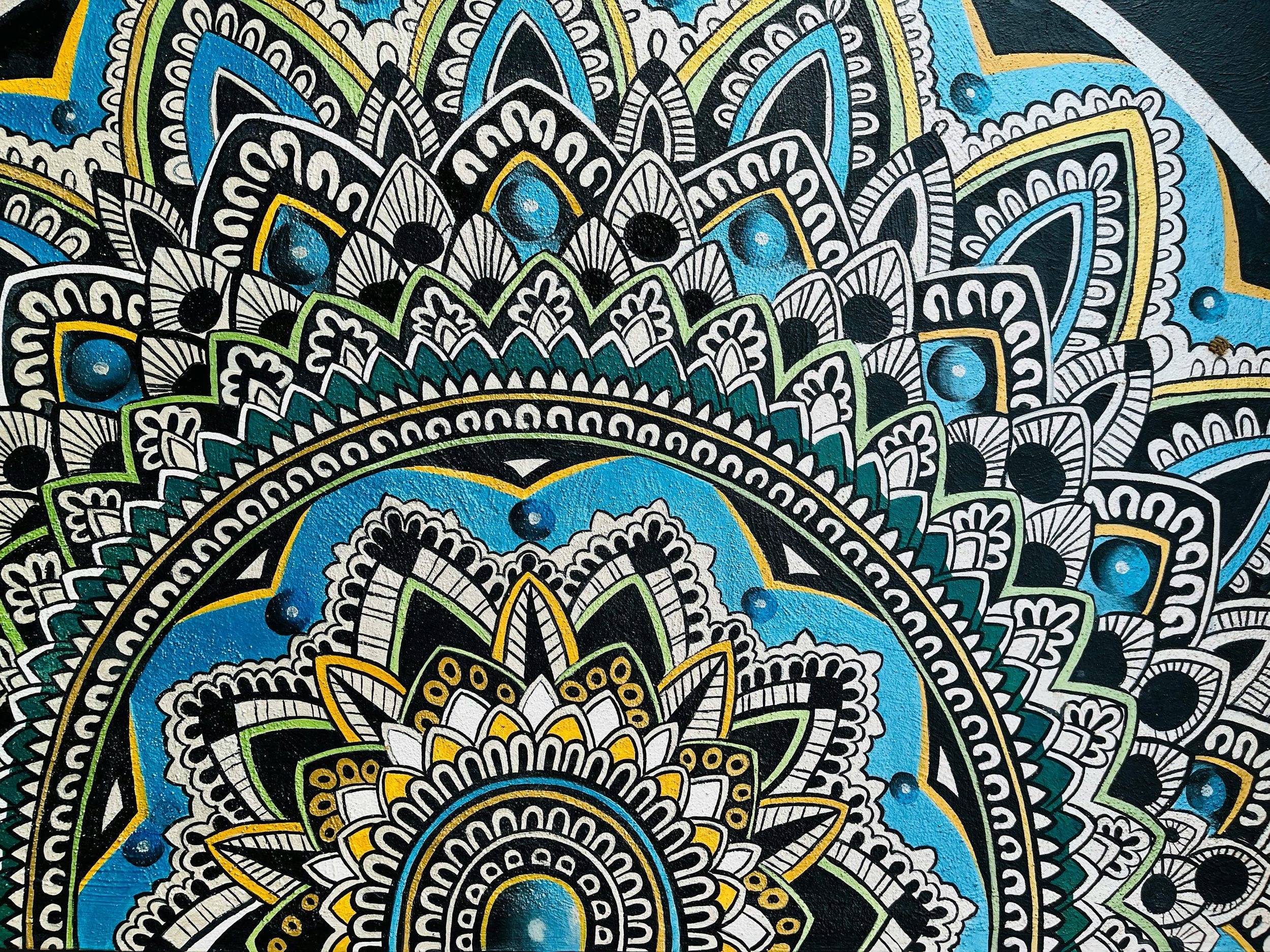
Pic: Snehanshu Dharmadhikari
Mandala (pronounced MAN-duh-luh) is the Sanskrit word for circle, or, more accurately, a disc, a sort of contained world. So think less of a physical drawn shape (I could never draw circles anyway) and more of a bounded space with something held inside it. Like a cricket boundary with cricketers inside, or like a frying pan with a thin layer of rice. Hopefully pilau, my favourite.
Actually, the concept of mandala comes from a tradition older than Buddhism, appearing first in Hinduism, in texts dating back perhaps three and a half thousand years, and the basic idea has remained consistent over that time: a geometric symbol representing the universe, used as a tool for meditation and focus. Circles within circles, patterns that pull the eye inward.
When Tibetan Buddhism adopted the form, it brought its own layer of purpose. The mandala in this tradition represents something closer to a sacred map, a symbolic cosmology, the structure of an enlightened mind.
I feel at this moment I want to join together by saying ommmmm, but I don’t want to appear flippant.
Monks create their own form of mandala from sand, large colourful circles of sand, intricate patterns (remember, circles within circles) and the ones doing it have trained for years before they’re permitted anywhere near one in a ceremonial context.
Again, without being flippant, it’s like starting a hobby and building up to the moment you can then practise your craft for a higher purpose, in this case, ceremony.
The work takes days, sometimes weeks, and multiple monks work together, starting at the centre, of course, and moving outward, placing grains of coloured sand using small metal funnels called chak-pur. The funnel releases a controlled stream of sand, not poured as it sounds, but guided.
The scale of patience required to lay down millions of grains into patterns of this intense intricacy, over that length of time, while people wander past taking photographs on their phones, fascinates me. I’m sure some visiting tourists imagine this to be a form of more recent entertainment rather than an age-old practice.
Once completed, everyone steps back, observes it, then someone steps in and simply brushes it away.
“What have you just done? That’s taken me weeks, that has.”
There are a few accounts of this unexpected end to something so beautifully and reverently created.
One is that, perhaps in a more traditional way, a door or window is opened, and the wind simply takes the mandala, or pattern, away.
It’s not quite true, as it happens, well, not today at any rate. The monks deliberately use a particularly dense sand, specifically to stop wind and accidental disturbance from undoing the work before they choose to.
The ending isn’t so passive. They do it themselves, with a ritual that mirrors the care that’s gone into the making. A lead monk draws lines through the finished pattern, horizontally, then vertically, and then others join in, pushing the sand inward until this intricate, weeks-long creation is a pile of grey-brown nothing.
The sand gets wrapped in silk, carried to a river, and released into the current. Whatever intention went into the making gets dispersed outward, rather than sitting there being admired. It’s beautifully tragic to someone who can only see it as a destroyed work of art, but to the monks, this is precisely the point: that nothing of value was ever contained in the object itself, only in the making of it, and in the release.
I suppose the romantic in me likes the idea of the breeze taking this creation, even though it leans on inaccuracy. Well, certainly by today’s narrative at least.
The wind taking the mandala suggests entrusting nature to reclaim something you have made, and it’s this uneasiness that probably doesn’t compute for most of us, including me. Because we are not like that at all, are we?
In terms of social media, we’ve spent the last decade and a half measuring how well our output is received, in real time, by as many people as possible, and we check those systems constantly. It didn’t start like that, from memory. I can’t remember thinking, “I wonder how many people have looked at this post,” not at the beginning.
The need to know started to creep in. It nudged into my life without so much as a personal introduction.
“Hello, I’m Social Media Validation. Strange name, I know, not even hyphenated. Anyway, I’m here to make you feel as good and as bad in equal measure. And I’m never going to move out.”
And actually, this didn’t affect just professional creators, it was pretty much everyone, if I can generalise for effect, or a moment. You put something out, you check back in within the hour, probably. Sometimes within minutes. Not because you’re vain, necessarily, but because these feedback loops, as they’re known, have been made so immediate and so easy to read that not checking, for some, for many, actually feels uncomfortable.
And to be fair to ourselves, it’s not all bad. If you’re running a business, if your income depends on reach, if you’re trying to build something that actually connects with people, the metrics, well, they matter.
An Instagram account with 20,000 engaged followers is a different proposition to one with a couple of hundred, and pretending otherwise is the kind of thing people say when they don’t need the money.
Validation has real-world currency. It opens doors, and it gets you taken seriously in rooms where you’d otherwise be invisible. I’m not interested in making a pious argument that none of it counts, because that just wouldn’t be true.
But I do think there’s a thing that begins to invade your conscience.
You start making work, or at least you did once, because there was something you wanted to say or show or figure out. Then, at some point, you start anticipating the response before the work is finished.
You make small adjustments because you know doing it this way or that gets more thumbs up or heart emojis. And the metrics reward you for it, so you keep doing it, and eventually you look at what you’re making, in all its competent, well-performing glory, and realise that it doesn’t feel like yours anymore. Well, not in quite the way it did.
The monks building the mandala couldn’t do this even if they wanted to. The design is prescribed, passed down, and mapped to specific teachings; personal innovation is largely forbidden.
Every grain goes where the tradition says it goes. But within that, there’s still a level of attention being paid to the thing itself, to the rightness of the making, that has nothing to do with how it will be received, because that question is entirely absent from the process. No audience is shaping the work from the inside.
“But where’s the creativity in that?” you might rightly ask. And I think you might have more than a grain of sand of a point in that. “Surely the fun, or the pleasure, is in making something that surprises people.”
But there’s a difference between making something and then sharing it, and making something in anticipation of how people might receive it.
I think that sequence means a lot, because once the audience is inside the creative process from the beginning, it changes what gets made.
The weeks of mandala work done with complete attention, knowing the whole time that the ending is already decided, and that nobody’s approval changes what gets built or how carefully it gets built, must be really refreshing to the soul, if you don’t mind me getting all woo-woo for a moment.
The work just is what it is, without any of that noise around it. You’re not checking in constantly across the weeks to see how it’s being received, although I guess there’s a little anxiety hoping that the new cleaner hasn’t bought one of those autonomous vacuum units that runs around in the middle of the night.
“Has anyone seen my mandala? It was there yesterday.”
Here’s what mandala-creating monks understand that the algorithm doesn’t, and maybe never will. The likes don’t last. They never did, they never will. The post that got three hundred hearts in 2023 is buried so deep now that even you’ve forgotten it.
It’s taken me a while to go over and over in my mind how to resolve this piece, but I think I have it. Go with me.
The sand mandala that took three weeks to build and thirty seconds to sweep away didn’t vanish without a trace. It went into the river, yes, but also into the people who made it, in terms of their creative and meditative purpose, and I think that’s an understanding about permanence that, whilst trickier to think about than “how many people saw it as they swiped by and left a like,” has a degree of honesty that a post peaking on a Tuesday and forgotten by Wednesday simply can’t match.
Perhaps there’s another way to think about this, too.
The likes don’t last. The making might.