


I wasn’t sure a tortoise was something I could feel comfortable owning. My brain defaults to dogs, cats and rabbits: animals that feel like they belong in a house, that have spent centuries working out how to live alongside us.
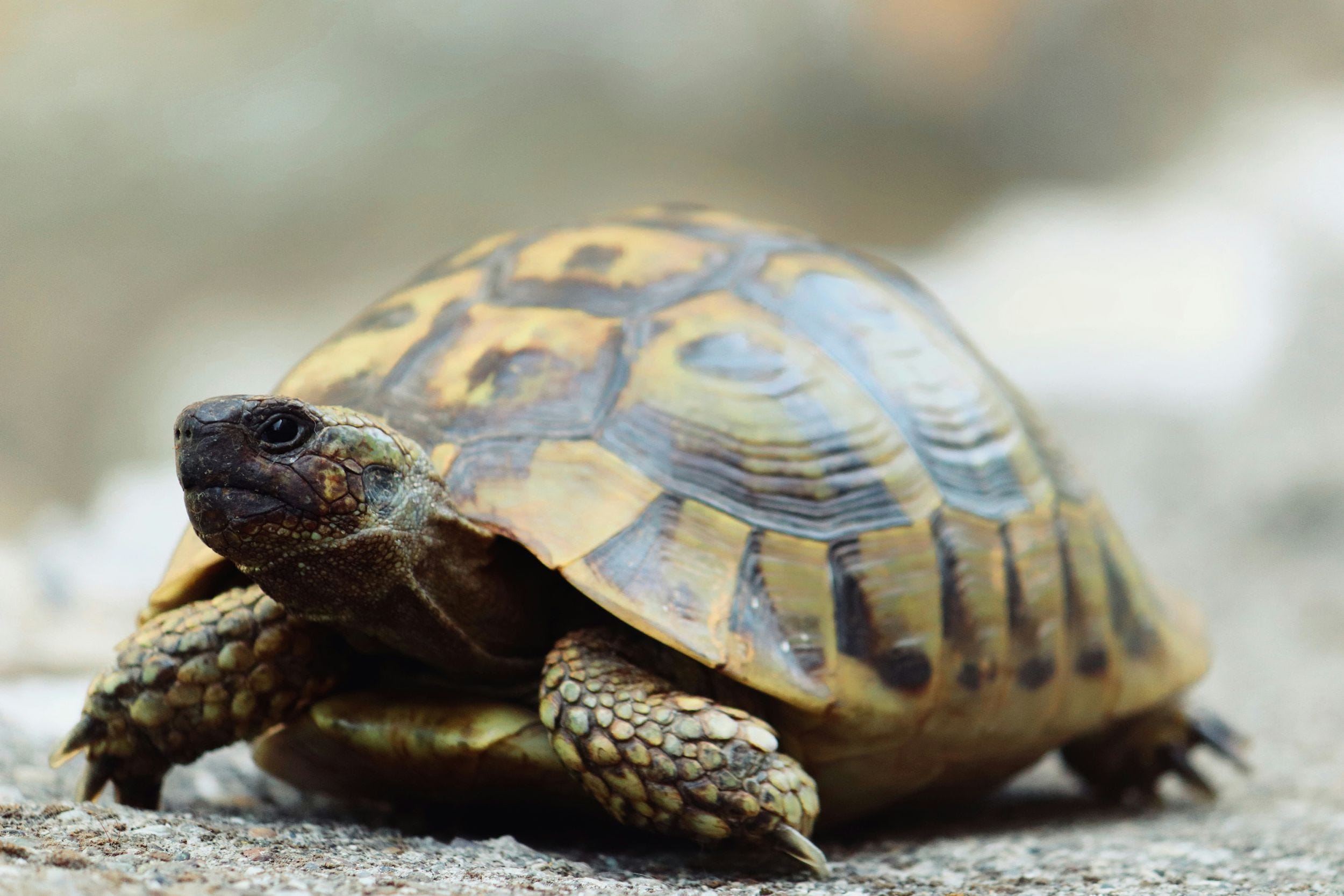
Pic: Anna
But a tortoise? I wrestle with keeping creatures that aren’t native to where I live because there’s a genuine moral question that I don’t think I can just wave away like an Asian hornet, which is equally not native to these parts and many times less desirable to look after.
But perhaps, and this is my get out of jail free card, there is something unexpectedly valuable about caring for an animal with more exotic requirements. A dog fits around your life. Well, except mine, who has me most certainly fitting around his.
A tortoise isn’t particularly high maintenance. They certainly don’t jump on your head at 5.47 in the morning, a whole hour ahead of walkies time, with over-enthusiastic and clearly over-ambitious intent.
But you do have to learn its world.
Most people assume the shell, for instance, to be basically a suitcase, just something a tortoise lives inside, but it’s actually fused to their spine and ribcage and packed with nerve endings. So if you scratch it gently, they can feel it, and some of them clearly enjoy it.
What also catches new owners off guard is how unforgiving the temperature requirements are, not just for comfort, but because once a tortoise drops outside its required range, digestion and immune function can essentially stop working. Get it wrong, and you’re not dealing with a cold animal; you’re dealing with a sick one.
Then there’s the personality question, which nobody really prepares for. People expect something passive and decorative, and instead they get an animal that might blank them for a fortnight because it’s decided it doesn’t trust them yet. And if you do build that trust and find yourself wanting to rehome one someday, you might discover that certain species, Hermann’s tortoise included, require a special certificate to buy or sell legally in the UK, which tends to come as a surprise.
And then there’s the age thing. Dogs and cats that live to twenty plus are thought of as rather special and somewhat blessed, but a tortoise is almost certainly going to outlive you comfortably, and by some margin, perhaps by fifty to a hundred years. You’re not just choosing a pet. You’re making a decision that will need to be written into your will.
That leads on to this reptile thing, of course, because that’s what it is. And whilst it’s not exactly some kind of viper that could possibly kill you if it escaped and you ended up rolling over on to it in the middle of the night as it found a warm place to kip, it is a member of a family of creatures older than the ark itself. Three hundred and ten million years of evolving, bloody slowly.
It won’t outrun you, or sting you, or strip your vital organs of the ability to function with one unfortunate nibble. Think of a tortoise less as the overexcited PE teacher fresh out of university with a clipboard full of initiatives, and more as a retired history teacher who has embraced sunbathing more than you would imagine and enjoys cucumber.
Imagine being nature and pitching the tortoise idea. You can imagine the focus group, can’t you, as this idea was brought to the table?
“Right, I’ve got a new creature.”
“Go on.”
“It’s basically a walking coffee table.”
“Fast?”
“No.”
“Dangerous?”
“Not remotely.”
“What’s its defence mechanism?”
“It takes its house with it.”
Our tortoise has been with us, I would say, nigh on ten years now. His name is George, a good, solid, serious-sounding name.
George spends a lot of his life doing things very slowly. He doesn’t rush toward food as though he’s late for a meeting. He doesn’t panic because somebody else has got a better leaf. He just moves with this steady certainty that eventually he will arrive where he intended to go.
There’s something oddly confident about that.
Humans, meanwhile, have gone entirely the other way.
We answer messages while walking into doors.
We eat lunch standing up.
We say things before we’ve thought them through, then spend three years explaining what we actually meant.
I sometimes wonder what the world would look like if more decisions were made with tortoise timing.
Imagine a tortoise politician.
“What’s your response to this developing situation?”
Long pause.
A blink.
Possibly a small bite of lettuce.
“I’ll get back to you on that.”
Three business weeks later, he raises his head slightly.
“I have concerns.”
And honestly, compared with certain world leaders who seem to make announcements with the emotional stability of a shopping trolley on ice, it starts to sound quite appealing, doesn’t it?
Maybe the problem isn’t that some people move too slowly.
Maybe it’s that too many people move before their conscience has caught up.
That’s the beauty of my daily walks with my camera and journaling my thoughts here.
At the beginning of a walk, my head is usually still travelling at motorway speed. Lists. Worries. Fragments of conversations. Things I should’ve said. Things I definitely shouldn’t have said. The mind arrives noisy.
But photography, whatever kind you practise and whether you earn or not from it, refuses to work properly when you’re rushing.
You can’t really notice light in a hurry.
You don’t see the way rain sits on a gatepost or how evening light turns ordinary pavement into something almost theatrical. Those things appear when your internal engine finally drops a gear.
Sometimes I’ll stand for five minutes looking at absolutely nothing obvious. Just waiting. And eventually something reveals itself. A shape. A shadow. A moment where everything lines up for half a second.
And then sometimes, nothing ends up happening at all.
Perhaps people would understand each other better if we slowed down long enough for thoughts to fully appear.
If somebody tells you something painful, the instinct is often to fix it immediately. Respond immediately. Fill the silence immediately.
But some of the best conversations I’ve ever had arrived after a pause.
Not an awkward silence.
Slowing down lets thoughts finish forming.
It lets instinct get questioned.
It gives conscience time to tap you on the shoulder and say, “Are you absolutely sure about this?”
George never seems burdened by urgency.
He’ll spend ages examining one corner of the garden as though he’s conducting a land survey for future generations.
And meanwhile, I’m checking the time while brushing my teeth.
There’s probably a balance in all this. You can’t run a fire brigade entirely on tortoise principles.
Although even then, a tortoise firefighter would probably remain extremely calm.
Tiny helmet.
Slow nod.
“We will attend the blaze.”
Eventually.
But I do think there’s something deeply human about learning when not to accelerate.
Some of the worst moments in life happen because people react before they reflect.
Anger moves quickly.
Fear moves quickly.
Crowds move quickly.
Wisdom usually doesn’t.
Wisdom has a shell on its back and takes a while crossing the patio.
Perhaps that’s why I like photographing on walks so much. It forces me into the speed of noticing. The speed George already understands, naturally.
A speed where you remember that the world is not just something to race through.
Sometimes it’s something to stand still in.
Or at least shuffle through thoughtfully, carrying your house with you.
Thanks Jayant, appreciate your comment. I'll enjoy reading your article.
Hi Neale. Love this article! Yes, slowing down starts with an intention (which is the stage where I am now). Then it needs deliberate inaction. The observation, feeling and the pleasure folllows. So often, even with an intention, I want to jump to slowing down - thereby doing exactly opposite of what I intend to do! Here’s an article I just wrote about this a couple of weeks ago on a trip to India. Hope you like it.
https://iseelife.substack.com/p/what-does-slowing-down-taste-like?r=4ysalr&utm_medium=ios