


What a wonderful sound, a perfect sound, not necessarily a perfect recording, I grant you. After all, my hand is outstretched with my iPhone recording as close as I can get to one of the birdboxes in our garden for a few seconds while Mum is off doing what bird mums do, bringing home sustenance for her little ones. So it was a snatched recording, then a pretty brisk retreat. I can honestly get a little wistful and teary at these kinds of sounds, at particular moments.
NB: This is one of those pieces where the audio will undoubtedly have more contextual impact.
I suspect this piece is going to make you raise at least one eyebrow and question if I’ve been taking a mind-altering substance in the writing and recording of it. Truth be known, it’s been a piece in the making for a while, inspired most recently by walks in the warmth of early morning late Spring, watching Barney, my fluffy companion, lazily chasing butterflies along the towpath, listening to cassette recordings of the brilliant late-night radio monologues about life from the late Joe Frank, and finding myself increasingly filled with wonder at how strange it is that any of us get to be here at all.
No alcohol or mushrooms involved.
One in four hundred trillion.
It’s a very contested number, but perhaps the most quoted odds when it comes to the statistical improbability of actually being here on this planet, to have even heard that recording.
I’ve been hearing a lot of hot air and bleating of late, and I’m not talking about the beautiful sound of lambs in a meadow. I’m really referring to the ungrateful, embittered, sorrowful, angry, resentful, entitled, disconnected, messianic, spiritually numb, ruthless sounds of powerful men who are absolutely incapable of comprehending the simple wonder and gift of being alive.
I doubt they’d appreciate the sound of hatchlings and certainly not link it to the sheer incredible fortune of being here to appreciate the beauty of it.
If you have your faculties and the ability to move through the world with some freedom, yet sacrifice your own spiritual proclivity on the altar of power, status and the endless hunger to dominate, you may never fully notice the strange fortune of being alive at all. Especially when there are people who would give anything simply to experience the ordinary parts of living without pain or limitation.
In purely mathematical terms, those people in white lab coats who have an abacus large enough to work out long numbers all agree on one thing: whatever the number of improbability is, you, I, those fledglings, mama bird, and the person who built the birdbox, probably shouldn’t be here at all.
And yet somehow, against all of that, here I am, and here you are.
Breathing.
Thinking.
Remembering things nobody else remembers in quite the same way.
It’s a bloody miracle.
Whatever name or belief you give it, existence is astonishing.
The writer, Douglas Adams, understood this brilliantly in a book he wrote. He understood that existence is so wildly improbable that the only sensible response is either laughter or complete psychological collapse, and preferably laughter because collapse makes it difficult to enjoy a decent sandwich. I’m embracing my inner Douglas there.
In The Hitchhiker’s Guide to the Galaxy, there’s something called the Infinite Improbability Drive, a machine capable of taking a spaceship through every possible point in every possible universe at once. Which means that, statistically speaking, somewhere along the journey, the utterly impossible becomes briefly, alarmingly possible. A bowl of petunias may suddenly appear in deep space. A sperm whale can materialise several miles above a planet and have just enough time to wonder what on earth is happening to it before gravity introduces itself properly.
And perhaps that’s us.
Maybe consciousness itself is the ultimate improbability drive.
Against odds so ridiculous they become almost comic, atoms assembled themselves into something capable of listening to baby birds in a wooden box and feeling moved by it. Matter somehow became aware enough to notice birdsong, feel grief, see sunlight reflecting on water, or appreciate the smell of rain in woodland, and, I’ll level with you now, also comprehend the unbearable sadness of knowing none of it lasts forever.
Which is in itself, extraordinary really.
The universe, after billions of years of hydrogen knocking about in the dark, eventually produced a creature capable of standing in a garden whispering, “have a listen to this,” into a microphone, which let’s face it is a bonkers invention that is completely improbable when you think we’re all descended from something that is a single amoebic cell.
Let me embrace my inner Douglas again to note that perhaps religion would clear its throat at this point and say, “Well yes, this is where I come in,” while science would already be halfway through a complicated diagram involving carbon chains and probability theory.
Douglas Adams would probably be standing at the back of this argument making tea, muttering that whichever side is right, it’s still astonishing that a species capable of inventing leaf blowers can also write symphonies, fall in love, and cry at the sound of hatchlings hidden in a wooden box.
I think that my photographic habit, my desire to record sound, my more recent desire to write down what I feel, is the gift that I’m only just starting to realise is so much more important than the pound notes it has earned to help me pay a mortgage.
I’ve been too busy running on the hamster wheel to notice that most of us simply don’t stop.
We rush past existence as if it’s guaranteed. As if waking up tomorrow is part of some signed agreement. We fill our heads with deadlines and shopping lists and notifications and the low-level static of modern life until we become numb to the fact that any of this is happening at all.
Then something interrupts it.
A diagnosis.
A birth.
A funeral.
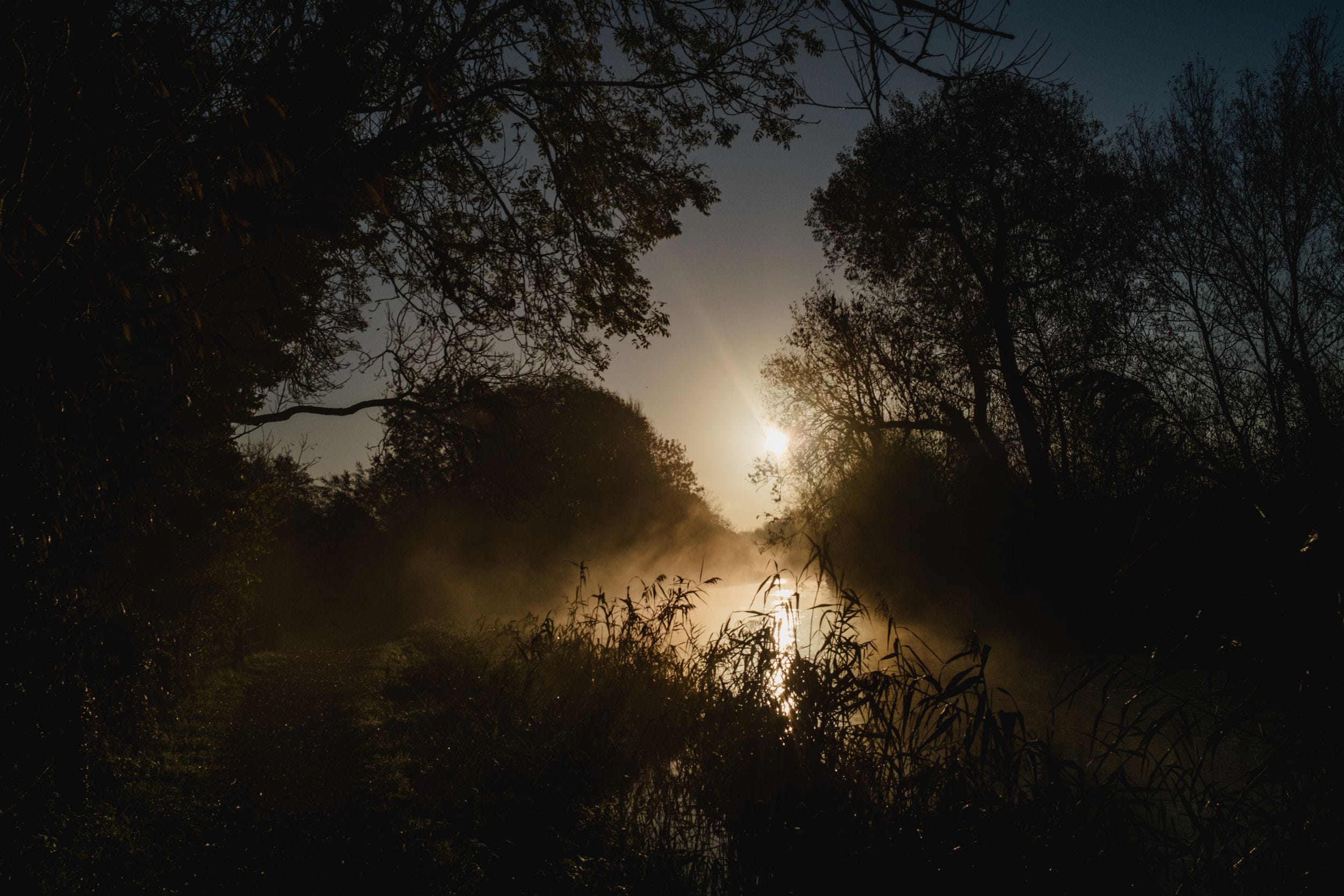
A blackbird singing at five in the morning when you can’t sleep.
And then, by magic, the world slips back into focus for a moment.
You remember you’re inside something miraculous.
Not miraculous in the glittery motivational poster sense, or the influencer saying how awesome blueberry muffins are, something more improbable than that.
I nearly called this piece ‘gratitude,’ but that seemed as plain as vanilla ice cream when Ben and Jerry’s Peanut Butter Cup Ice Cream is on the same menu. Gratitude gets misunderstood because it’s presented like homework. You keep a journal, write down five things a day, and so on, but real gratitude doesn’t seem to appear in my life like that. I think it happens when I hear rain falling on leaves, or when I hear a blackbird singing into the last few minutes of daylight and feel, for reasons I can’t properly explain, grateful that I was around to hear it. That was a favourite sound from my grandmother’s back garden, on hot, lazy summer evenings when we went to visit, and I was still in single-digit age numbers.
But come on, those little sounds from the bird box I recorded. The frantic peeping of new life demanding food before they even understand what life is yet. Creatures no bigger than a thumb arriving into existence with absolute determination. That is magic.
Maybe gratitude begins there. Not with possessions or achievements, but with awareness.
Because once you really notice things, materialism starts losing some of its grip.
Not entirely. We all like comfort. Nice things. I’m not pretending otherwise. But when people reach the end of their lives, they rarely ask for one last chance to sit in better traffic.
They want more sunsets.
More conversations.
More time with the dog asleep beside them.
More walks.
More ordinary Tuesdays they once thought were forgettable.
It’s perhaps a melancholic musing, but every now and then, I find myself wondering what it would feel like if you knew you were about to read a story to your child for the last time, because they no longer need you to, or no longer want you to, or because something like TikTok has stolen their attention instead. I think you’d read those final few pages very differently. You’d probably hang onto each sentence a little longer.
Life is full of endings that don’t announce themselves, like that, including the last time your children want to hold your hand in public.
The final time you hear a friend’s laugh before illness changes it.
And because we don’t know when those moments arrive, they pass through our hands disguised as ordinary life.
Maybe gratitude is simply understanding that ordinary life is not ordinary at all.
Look at what we get.
The taste of cold water when you’re thirsty.
Bread still warm from the oven.
Warm coastal wind against your face.
The strange comfort of hearing children shouting and laughing at lunchtime in the school playground.
The smell of cut grass drifting through an open window.
A dog losing its mind with happiness because you came home.
Music that somehow understands your feelings better than language does.
Laughter that arrives at the completely wrong moment and makes everything worse and better simultaneously.
Even grief, in a strange way, points back toward gratitude. We grieve because something mattered. Because we loved. Because we were lucky enough to encounter someone or something worth missing.
That’s the deal, really.
To be alive is to become vulnerable to loss.
But the alternative is nothing at all.
No birdsong.
No rivers.
No taste of coffee.
No autumn light through trees.
No voice saying your name.
Nothing.
And despite all the pain stitched through human existence, most people still cling fiercely to life. Even difficult lives. Even broken ones.
That says something enormous.
Somewhere underneath all our complaining and worrying, we know this experience is extraordinary.
A consciousness able to observe itself, and this is about as scientific as I can muster, atoms contemplating atoms.
The universe becoming aware enough to hear a blackbird sing.
I know that sounds grand, maybe even slightly mad, but sometimes late at night it genuinely hits me. Out of all the billions of years before I arrived, and the billions that will come after I’m gone, I get this brief flicker.
This tiny candle of awareness.
I get to see trees.
I get to love people.
I get to stand in a kitchen at midnight eating toast while the house sleeps.
That’s unbelievable when you think about it for more than thirty seconds.
Maybe that’s why nature affects us so deeply. It pulls us back into the present tense. A stream doesn’t care about your unread emails. Birds aren’t interested in your status or your bank balance. The wind couldn’t give a monkey’s that you have ten less subscribers than you had a couple of days ago. The natural world keeps asking the same question:
Are you here?
Not tomorrow.
Not yesterday.
Now.
Can you hear this?
Can you notice your own existence long enough to understand how strange and beautiful it is?
Like a message scratched into a tree, or sprayed onto a wall; I was here.
I heard the hatchlings.
I felt the wind.
I noticed.
Valid point Ross, valid point! 😂
That's beautifully written Neale, lots to contemplate, mind you, one thing I would disagree, I think I'd prefer some quality vanilla ice cream over something called Peanut butter cup. 😊