


If you’re a Harry Potter fan, you’ll be familiar with Honeydukes Sweet Shop. This emporium of ever so different confectionery sold Chocolate Frogs that leapt out of their boxes with collectable cards tucked inside (the box, that is, not the frog), Bertie Bott’s Every Flavour Beans that genuinely tasted of anything from strawberry to earwax, Fizzing Whizzbees that made you float, Exploding Bonbons that did exactly what the name suggested, and Sugar Quills you could chew in class.
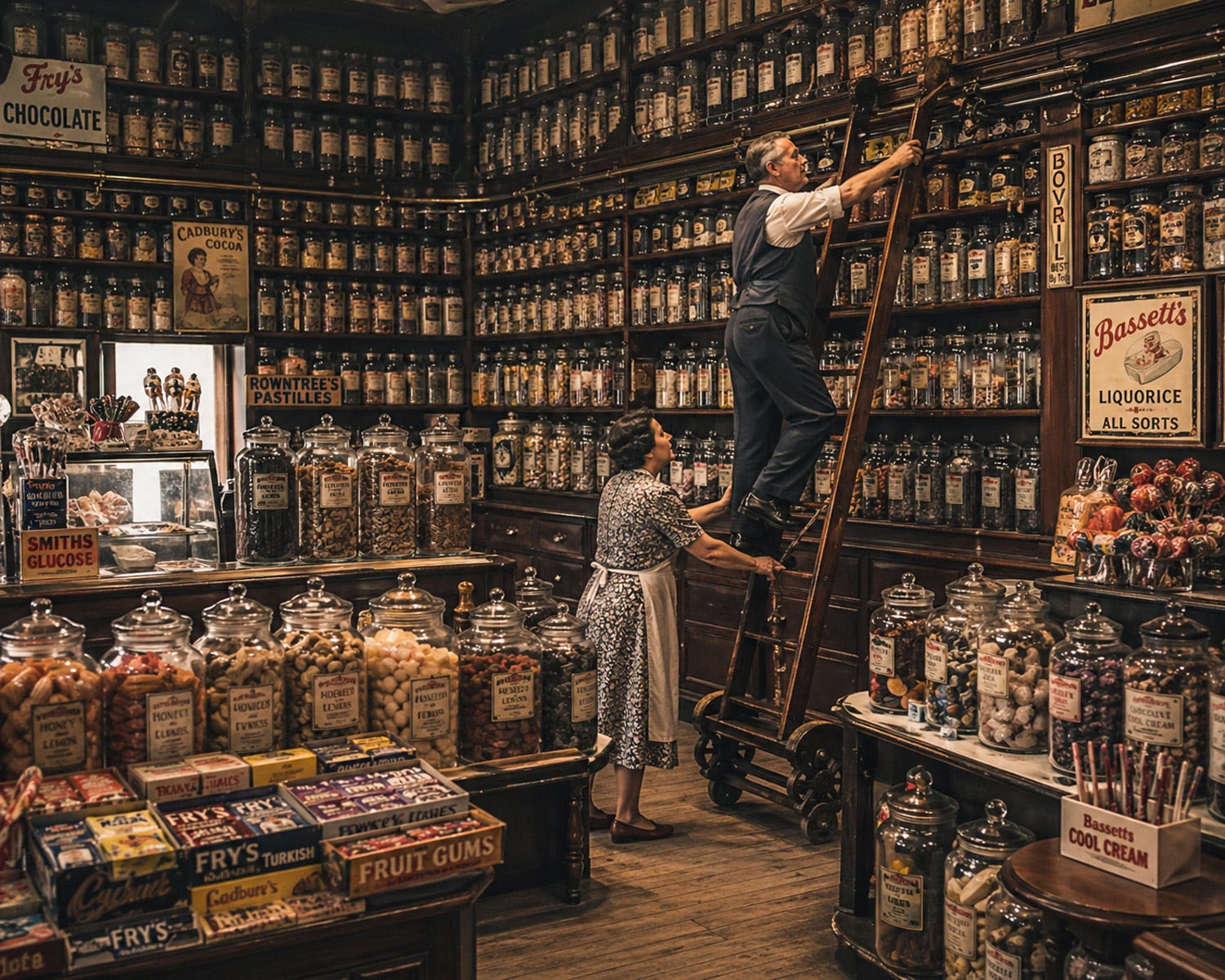
What the shop could have looked like. Well, it certainly is in my memory.
Honeydukes had this Victorian veneer about it: a sweet shop from a bygone era, not like your average pile-it-high, sell-it-cheaper, because-the-bars-are-a-third-smaller-than-they-used-to-be shop.
Having said that, I come from an age when I remember a Mars Bar was ten to fifteen pence. They were one of my favourites, and I could confidently make one last an hour, chewed oh so very slowly. I grabbed a coffee the other day on a dog walk and went to buy one, but they’re now £1.30. Well, there they are. I made do with the coffee.
But if Honeydukes looked special, you should have visited my Grandad’s place in Enfield, just north of London’s metropolis. It sat in a parade of shops, flanked by a greengrocer and the kind of pharmacy that, in its day, John Pemberton would have sold original Coca-Cola from. That’s how I remember it: wood-panelled, traditional and, like something out of a museum, even then, as a child.
Despite decimalisation, Grandad refused to change the main cash register, one where those tickets flicked up to show the final tally, one of those big brass sit-up numbers that did a proper ker-ching when you opened the drawer. There were others, but that was Grandad’s till and, from memory, he was quite protective of it.
Saying I grew up in it is a little far-fetched, really, in that it was my playground when I went to stay or visit.
The place still has a strong magical draw, even though Grandad Harry and his wife, Grandma Rose, left this world more than three decades ago.
Now, as a photographer talking to other photographers about visiting far-flung places or unfamiliar locations, I often suggest it’s like photographing in a candy store; everything looks wonderful, different, and intriguing. What may be normal to one person who has seen the same view thousands upon thousands of times over will be a scene more extraordinary to, say, me.
My Grandfather’s shop was a fantastical place, much like Honeydukes, so I thought I’d go look it up on Google Street View and, when I found it, my heart frankly sank.
“Oh, look at that, it’s dreadful. What’s happened to the amazing façade it had? Where’s the worn-out olive green sun and rain shelter? Where’s all that beautiful wood panelling and lovely old door to match?”
It’s become completely charmless, with a horrible, small neon “OPEN” sign and an invitation to “pay your bills here.” The main door is now set in some form of aluminium frame, no different to all the others in the parade, and it’s turned into a shop that sells everything. It’s gone from being the Honeydukes of my childhood to just another shell full of stuff.
We had a living museum, and we took it for granted. There’s barely a photo left in the whole ever-decreasing family, so perhaps it falls to me to share what this looked like and, though it may not be a photograph you can reference, perhaps you can, in the developing tray that is your mind and imagination, go with me.
H.A. Stewart’s, tobacco, and confectioners, with, for the favoured few, if you walked through the shop, a lean-to where Harry cut your hair on proper pump-up chairs. Apparently, he was a trained barber, though Mum let him go nowhere near my hair as a child.
The shop had, at one stage, decorative windows that in today’s money would be Grade One listed, I’m sure. They were etched and hand-painted with the words Fry’s Chocolate. They stood proudly as a nod to an era where stickers weren’t the advertising collateral. You had hand-painted signs within hand-painted windows, and Grandad’s shop carried this display proudly for decades and decades, until...
It was Boxing Day, nineteen-seventy-something, and Harry opened the shop despite protestations from the family.
“It’s Christmas, Harry, ‘ave a couple of days off,” the family chimed in unison.
“Rose,” he said, because he rarely listened, or indeed left the shop, “I’m opening up for a couple of hours.”
Harry Stewart loved a round of golf, and actually, he did leave the shop during opening hours every Thursday to play a round at Winchmore Hill Golf Club. He allowed himself this luxury at least.
His clubs were always on hand just out back in the living quarters part of the shop, as they indeed were this Boxing Day occasion in nineteen-seventy-something, when for some reason he and a customer decided to settle a wager that my Grandfather couldn’t drive a golf ball across and over the busy Great Cambridge Road, a dual carriageway that was the main northern arterial route into London, from inside the shop.
Whilst plausible, there were factors like trees on each side of the, shall we call it, urban fairway, a busy road that was rarely quiet, even at Christmas, and a doorway opening that meant your shot would need to rise sharply if it were to clear the paths, the single parking road adjacent to the shop, then the dual carriageway itself, missing the flow of traffic and arriving at the other side, hopefully landing on the grass verge in front of a row of houses, without striking vehicles or people.
This is obviously utter madness, but my Grandad had a wonderful eccentricity that sat well with the challenge, and so, unbeknownst to the family, who were out back preparing a Boxing Day feast or watching telly, the shot was set up. A makeshift tee was made from something, probably a 15p Mars Bar, and my grandfather lined up the shot.
Steady as he goes, feet planted, knees softly bent, arms loose at the address, one last look at the target, then eyes down on the ball. He draws the club back and up, weight shifting to the back foot, a breath held at the top of the swing, and then the downswing, hips turning through first, arms following, the clubface meeting the ball with that satisfying crack and then...
He properly shanked it, the ball fizzing off at a vicious angle, smashing through the corner of the display window on his right before the glass gave way, a sharp crack followed by the tinkling collapse of the pane folding inward.
Done.
The family rushed out and looked on in horror. Fry’s didn’t make windows like this anymore, and this relic of a bygone era had just been taken out by a wayward golf ball.
One thing you need to know about Grandad Harry is that he could never be wrong. He’d destroyed this historical signage, but rather than cower in the corner, horrified by this ridiculous act of needless self-vandalism, he found fault immediately in the low sun blinding him for a split second, the split second of the strike.
H.A. Stewart’s had a sort of den at the back of the shop, behind the counter, which you entered through an opening, from memory, framed by an architrave. This den was shelved on every surface you could find, and a shelving unit sat in the middle, packed tight with every leading tobacco and mixing jars.
It’s not fashionable to say, and I’m pleased I didn’t end up a smoker or pipe artist like my grandfather, but the smell of that den was exquisite. The old wood, this sweet, almost caramel warmth of pipe tobacco that had been smoked in that room for decades as my grandfather mixed special blends for customers, had simply become part of it.
As a child, it felt like a hidden room from another century. Customers would lean on the counter and lower their voices slightly when discussing their mixtures, as though they were talking to a tailor about a suit. My grandfather knew them all. One man liked something darker in winter. Another wanted a blend that reminded him of whatever he’d smoked during National Service. Names were written in pencil on little cards tucked behind jars, the handwriting fading after years of fingers and tobacco dust.
Some of those special customers were football players, names from his beloved Tottenham Hotspur, who would pop into H.A. Stewart’s to buy their tobacco before turning up to play.
And then there was the shop itself.
Grandma and Grandad’s sweet shop seemed to stretch upwards forever. Dark wooden shelves rose from the floor to the ceiling, wrapping around the walls in a great horseshoe shape, every inch occupied by glass jars, tins, packets, and boxes that looked as though they had been sitting there since before the war. New brands may have appeared here and there, but the bones of the shop belonged to another age.
The shelves were packed so tightly that it was hard to imagine how anyone kept track of it all. Great bell jars stood shoulder to shoulder. Inside were pear drops glowing amber and gold beneath the lights, mint humbugs twisted like little barber poles, sherbet lemons, aniseed balls, cough candy, barley sugars, winter mixture, Everton mints, liquorice torpedoes, Pontefract cakes, clove rock, army and navy sweets, cola cubes, acid drops and floral gums that tasted faintly of perfume and old ladies’ handbags.
There were coconut mushrooms, chocolate limes, treacle toffee wrapped in greaseproof paper, and little paper twists filled with mixed boiled sweets, weighed out on brass scales that I was allowed to measure.
The adult sweets sat slightly apart from the children’s treasures, as though they belonged to a different world entirely. Liquorice root stacked in bundles. Hard black cough candies and menthol sweets for throats roughened by cigarettes and cold weather. Dark toffees that could pull a filling loose if you were careless.
To reach the highest shelves, there was a ladder. It ran on a brass track fixed all the way around the shop, curving neatly at the corners so the ladder could glide without stopping. To me, at that age, there was only one other place that had something like this: the old library in our hometown. My grandfather moved along it with complete confidence, one hand reaching for jars while my grandmother steadied the base and gently pushed him onwards. He would collect things as he travelled: a tin from one shelf, a jar from another, packets tucked beneath his arm with the ease of a man who knew every inch of the place blindfolded.
From below, as a child, it looked almost magical. The ladder creaked as it rolled along the curved track above the counter, my grandfather suspended amongst hundreds of jars and colours and smells, like the keeper of some enormous edible archive.
“Rose,” he’d shout, “catch this,” and he’d drop from height one of those large glass jars full of pear drops, and my grandmother would somehow catch the jar, place it on the counter and ready herself for the next, which on this day arrived sooner than expected...
What happened next became part of family folklore for years afterwards, and I shall tell you that part of the story in the next edition.